

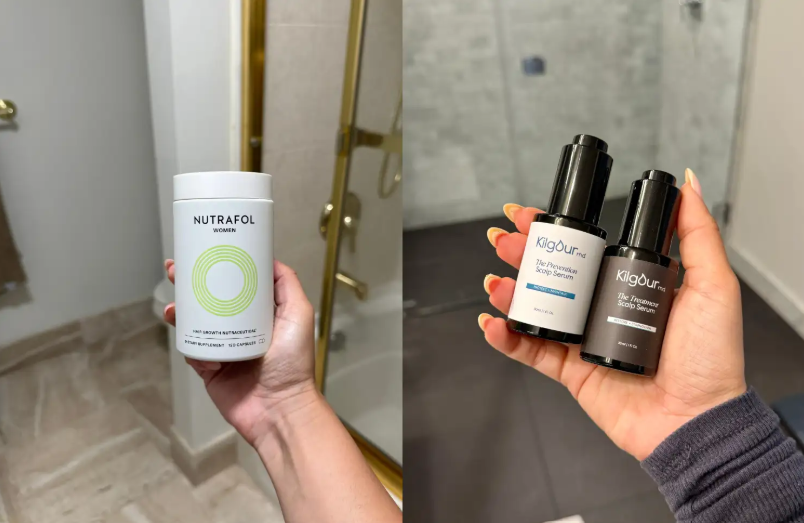
When my hair started thinning during menopause, I did what most women do: I panicked, then Googled.
Nutrafol kept coming up everywhere. So I subscribed, took my four capsules every morning, and waited. A few months in, I still wasn’t seeing much of a difference. I was also uneasy about taking such a high-dose supplement long term, particularly after learning that high levels of biotin can interfere with certain lab tests.
Around that time, a friend dealing with the same issue mentioned KilgourMD, a topical scalp system developed by a Stanford-trained dermatologist. I ended up pausing my Nutrafol subscription and giving KilgourMD a try.
Here’s what I found when I compared the two head-to-head:
Hair Growth Treatments Comparison
✅ Founded by Stanford dermatologist Dr. James Kilgour
✅ The Topical system targets the scalp directly
✅ Outperformed 5% minoxidil in clinical trials
✅ No systemic side effects or bloodwork interference
✅ 90 days Money-back-guarantee
❌ Higher cost – $150 one-time / $89 – $127.50 subscription
✅ Physician-formulated oral supplement
✅ Lower price point ($88 one-time / $70 – $79 subscription)
❌ 3,000 mcg biotin may interfere with thyroid and hormone blood tests, and can falsely lower cardiac troponin
❌ Documented liver injury risk from ashwagandha/saw palmetto
❌ Studies compared to placebo only, not pharmaceuticals
❌ Oral supplements may be less effective than targeted topical applications
❌ 30-day refund on unopened products only
1. Treatment Approach
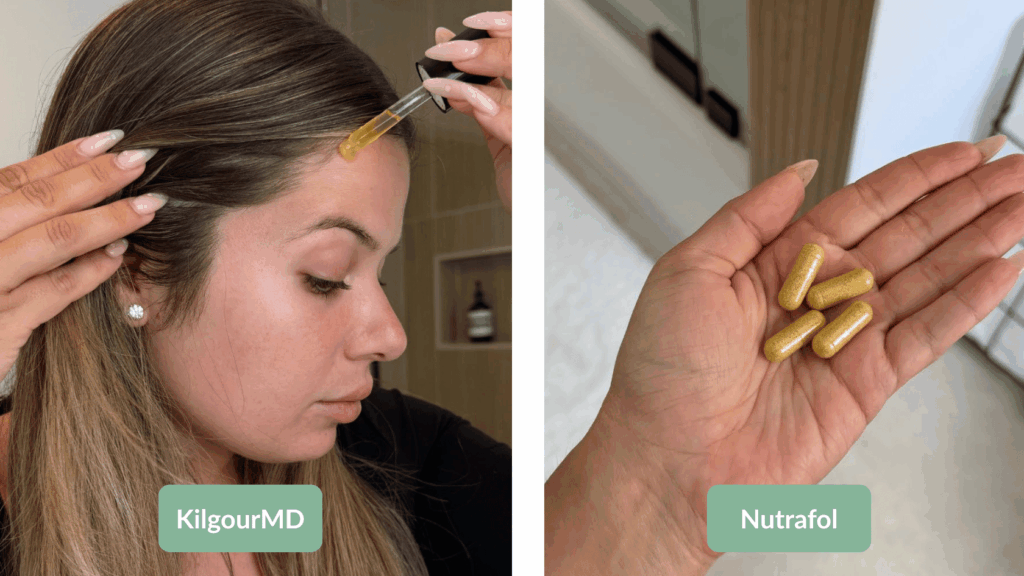
Nutrafol’s bestselling capsules work from the inside out. It’s a daily oral supplement, designed to address internal contributors to hair thinning like stress hormones, inflammation, and nutritional gaps. The logic makes sense in theory: fix the body, fix the hair.
KilgourMD takes a completely different approach, one rooted in newer research. A 2020 study published in PNAS found that even healthy hair follicles struggled to grow in an aged scalp environment, meaning the scalp itself is often the problem. KilgourMD’s two-serum topical system applies directly to the scalp, where thinning actually starts. The Prevention Serum targets excessive shedding, while the Treatment Serum reactivates dormant follicles. It’s targeted, precise, and works at the source.
2. Clinical Evidence
Nutrafol has 20 published clinical studies, which sounds impressive. But most are brand-funded, with small sample sizes of 40 to 100 participants, and compare results against a placebo rather than any established hair loss treatment.
KilgourMD’s formula is built around three clinically studied botanicals, Redensyl®, Capixyl®, and Procapil®, and has been evaluated in a clinical trial published in the Journal of Drugs in Dermatology for women with female pattern hair loss.
It’s also been tested against 5% minoxidil, the active ingredient in Rogaine and one of the most widely used hair loss treatments available. KilgourMD outperformed minoxidil for both hair density and visible shedding reduction. By week six, 95% of users saw a measurable decrease in hair fall during brushing and wash days. That’s a much higher bar than a placebo comparison.
3. Safety and Side Effects
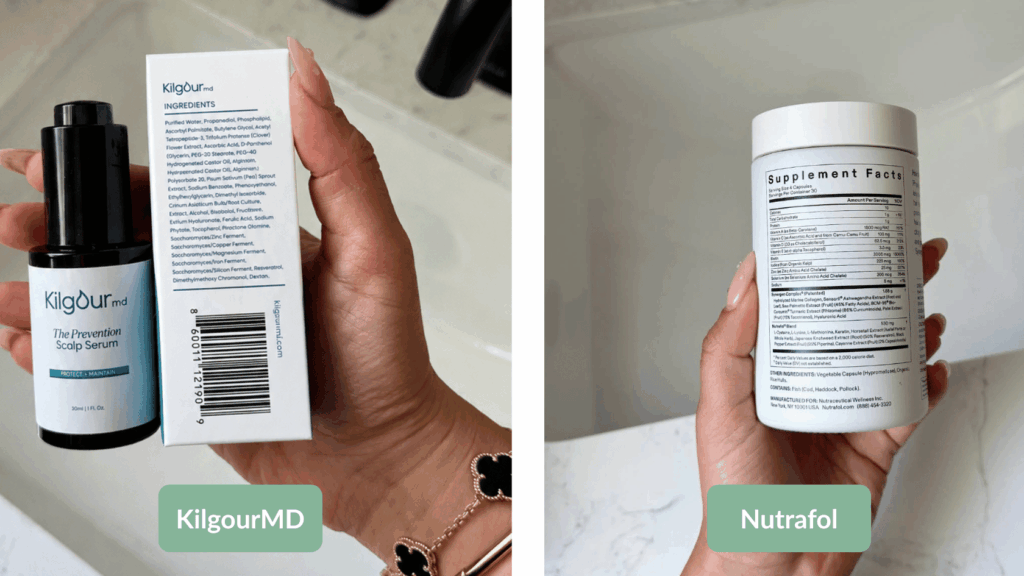
Nutrafol contains 3,000 mcg of biotin per serving. That’s 10,000% of the recommended daily value! At that concentration, biotin has been clinically linked to interference with thyroid, hormone, and cardiac blood tests. For women in perimenopause (exactly who Nutrafol markets to) that’s a genuine concern. Beyond biotin, a 2024 case report documented severe liver injury in a Nutrafol user, with ashwagandha, turmeric, and saw palmetto identified as likely contributors. The NIH’s LiverTox database lists ashwagandha as a documented liver-toxic agent. Nutrafol contains all three, taken daily, for 90 or more days.
KilgourMD is applied topically rather than swallowed. There are no systemic side effects, no documented bloodwork interference, and no risk of supplement interactions. For anyone managing regular hormone or thyroid testing that peace of mind is significant.
4. Results and Experience
Nutrafol requires you to take 4 capsules every morning. After three months, you’re supposed to see an improvement in overall shedding.
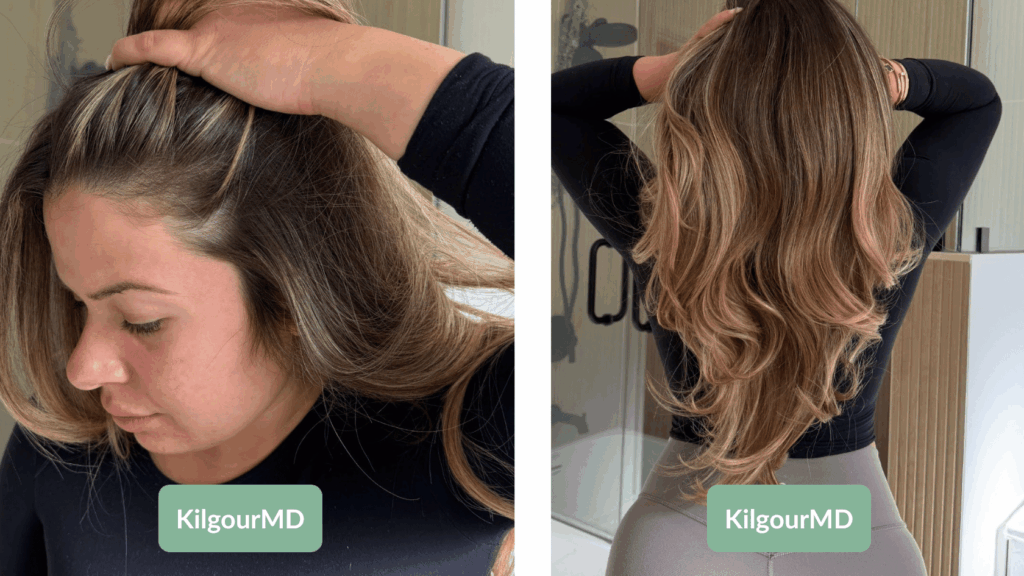
KilgourMD takes six weeks until you notice results. The change during wash days was unmistakable. Far less hair in the drain, noticeably less on my brush. By month three, I was seeing new growth along my hairline. The serums absorb quickly and don’t leave any residue, which I’d been worried about. Genuinely one of the most pleasant-to-use products I’ve tried.
5. Value and Refund Policy
Nutrafol costs $79 per month on subscription, which is accessible. But here’s the catch: their refund policy only covers unopened products within the first 30 days. That means you’re taking on full financial risk before most hair growth studies even begin to show measurable results (which typically takes 90 days or more). Even their 6-month plan only drops to $70/month, an 11% discount off the regular price.
KilgourMD costs $127.50 per month on a monthly subscription. The 90-day plan brings that down to ~$110/month (27% off), and the 6-month plan to $89/month (41% off!). Yes, it’s pricier upfront than Nutrafol, but the 90-day money-back guarantee actually matches the treatment timeline, so you’re not locked in before you can judge results – making the higher sticker price easier to justify.
My Honest Verdict
Nutrafol has a lower entry cost, and for some women, a supplement-based approach may work. But for me, the reported side effects (especially high biotin levels affecting bloodwork), were hard to ignore.
KilgourMD delivered visible results faster, by week six, without those trade-offs. Developed by a Stanford-trained dermatologist and used by clinicians, it’s the best option for me.
I canceled Nutrafol and haven’t looked back. If you want a non-systemic, clinically grounded approach to hormonal hair thinning, I recommend trying KilgourMD.